Love to knit or crochet? You can join in the Melt the ICE movement!
In St. Louis Park, Minnesota, a suburb fewer than five miles from downtown Minneapolis, in an area where the federal paramilitary organization ICE is actively engaged in abduction, murder, and the sowing of chaos, an independent knitting shop has taken inspiration from history to create a brand-new craftivism movement.
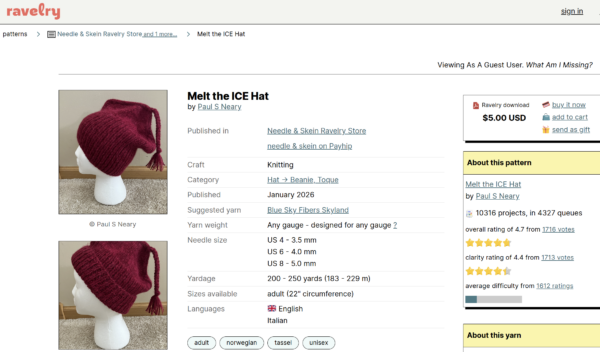
The Melt the ICE hat is a knitted red beanie digital pattern created by Paul Neary for the St. Louis Park knitting shop Needles & Skein. It calls for approximately 200 yards of the knitter’s choice of red yarn, and it can be knitted in any gauge. The pattern is currently listed in ravelry with over 10,000 projects, and a 4.7 star rating. The crochet version of the Melt the ICE hat was created by Sarah Sward. It calls for approximately 200 yards of worsted red yarn with 9 wpi and a 4.5mm or 5mm hook. It’s listed with over 400 projects on ravelry, and has a 3.9 star rating. Each Melt the ICE hat pattern costs $5, and they’re both sized for adults. These patterns allow fiber artists to create their own wearable protest symbol while actively helping immigrants in the Minneapolis area, as Needles & Skein donates all proceeds from the sales of the hat patterns to immigrant-centered local nonprofits. Knitters and crocheters are also invited to craft and donate Melt the ICE hats through Needles & Skein; those who can’t knit or crochet can purchase these hats, with 100% of the proceeds added to the donation pool. If you don’t need a hat or a pattern, you can also simply make a donation.
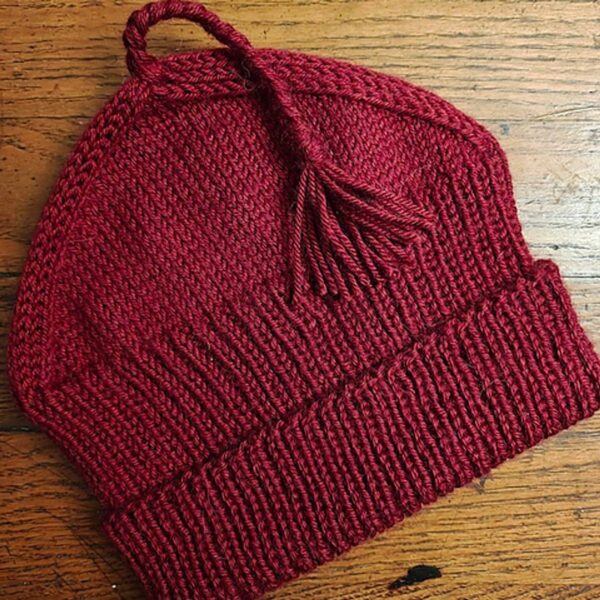
These Melt the ICE knitted and crocheted hat patterns have allowed Needles & Skein, a small business owned by Gilah Mashaal, to raise over $650,000 for local non-profits that focus on support for the immigrants in their community who are being actively targeted by ICE paramilitary agents. Organizations that have so far received donations include STEP (St. Louis Park Emergency Program) and the Immigrant Rapid Response Fund. These organizations provide urgent care such as food, housing, healthcare, and transportation, as well as assistance with legal services and other community education, advocacy, and mobilization activities.
The Melt the ICE hats are also a visible symbol of protest, reminiscent of “nisselue,” the tasseled red knitted hats that inspired Neary’s pattern. The nisselue is a traditional Norwegian hat that was first used for craftivism during the Nazi occupation of Norway in World War 2. Then, Norwegians knitted and wore it as a quiet symbol of hopefulness, at least until the Nazis outlawed it… and then many continued to wear it anyway. These current versions are a fitting callback both because Minnesota has the largest Norwegian heritage community in the country, and because in Minneapolis and in many other cities across the country, ICE agents are using many of the same methods of occupation, terrorism, and subjugation as the Nazis. I think the Melt the ICE hats are also highly reminiscent of the Bonnet Rouge of the French Revolution, if you have more of a sans-culotte mindset. Tangentially, I also find it interesting to think about how more traditionally “female” crafts like knitting have also been used more actively in war efforts–you might not be a World War 1 spy knitting codes into scarves, but if you’re a knitter, it’s nevertheless part of your legacy.
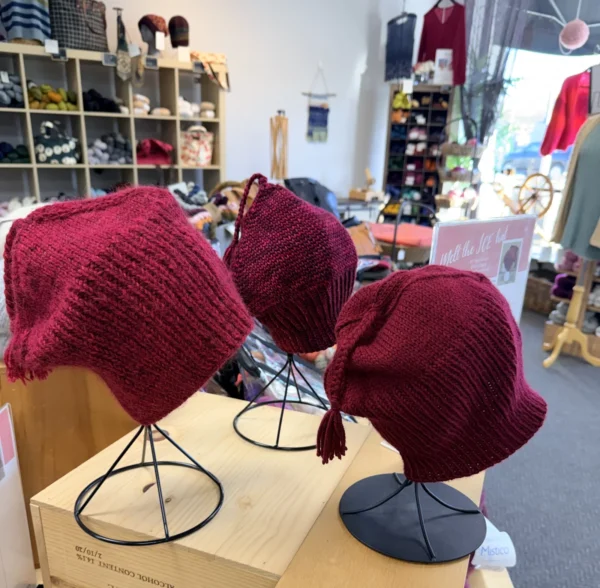
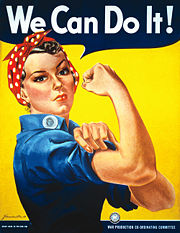
World War 1 espionage aside, fundraising for mutual aid and symbolism for solidarity, as part of the work that the Melt the ICE hats do, are two of the hallmark purposes of craftivism, and both are especially important during times when there are both real needs to be met and the danger that real people can find themselves feeling hopeless or alone in the face of what they’re experiencing. This red knitted hat both provides concrete support to the immigrant communities affected the most, and serves as a powerful symbol of connection between the likeminded. To those who call wearing protest symbology “performative,” I’d say that anything that bothered the Nazis so much that they banned it is definitely worth wearing in front of the fascists of today.
Visibility matters.
P.S. Curious about other ways that you can protest via craftism? Quilting and embroidery are other crafts that are very amenable to the inclusion of protest signage and symbology, and when created large-scale or as wearables, are also workable as signage for in-person protests. Crafters who prefer to work with paper, especially scrapbookers and journalers, can create embellished postcards to send to their representatives, and/or volunteer to create and send postcards to voters in swing states. Children’s crafts are also important for inspiring kids to be active, informed voters.