
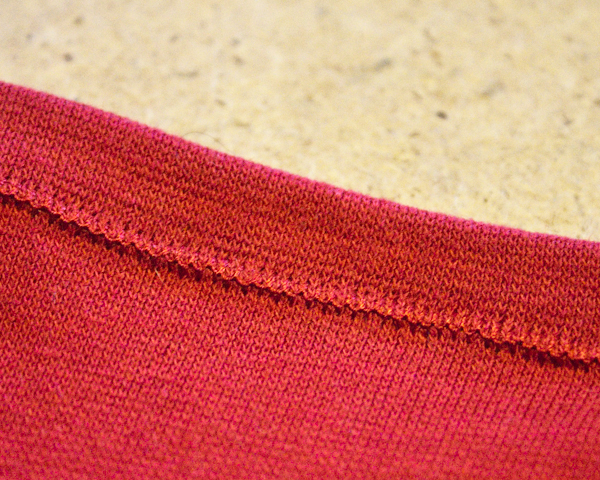
Revelation: You don’t need a serger to sew knit fabrics.
Sure, it can be nice to have a serger to sew knit fabrics, especially if you sew primarily knits or require the the special finishing techniques that you can only achieve with a serger, but it isn’t necessary.
It is possible to use a typical home sewing machine to neatly and sturdily sew knit fabrics, without the gathering, stretching, or pulling that you might anticipate.
So, whether you’re remaking an old rock concert T-shirt or sewing a skirt from a thrifted jersey sheet, here are the three stitches you need to know to do the job well:
- The zig-zag. A zig-zag stitch is perfect for knit fabric, because it stretches with the fabric, and thus is less likely to pucker or cause thread breakage. Choose the narrowest zig-zag stitch that will not pucker or stretch your fabric, since the wider/longer your stitch is, the weaker it will be. When sewing a seam, you can partially encase the raw edges by allowing one side of the zig-zag stitch to go slightlyover the end of the seam, mimicking an overcast stitch on a serger. You can also use the zig-zag stitch decoratively with knits, for instance by stretching the fabric as you zig-zag a hem to make a lettuce edge. Remember, however, that a zig-zag stitch is wider than a straight stitch, and adjust your seam allowance accordingly.
- The mock overlock. Even older sewing machines often have something like this stitch, although it goes by a variety of names and faces. The stitch looks something like an X with a horizontal line at the top and/or bottom, or perhaps a V with those same horizontal lines. This stitch, if you have it, is even sturdier than a zig-zag, and can also be used to finish your seams, though it’s also wider and uses more thread. It’s best for seams that will get a lot of stress, and not for smaller, more delicate pieces.
- Anything but a straight stitch. Really, the only stitch that is completely inappropriate for sewing knits is the straight stitch. A straight stitch has no margin to stretch with the fabric, and will simply break. Conversely, any specialty stitch that your sewing machine may have, such as a blind hem stitch or any reinforcement stitch and often many decorative stitches, may work if they contain components that are not just vertical, as the straight stitch is, but also have horizontal elements. It’s time well spent to try out such stitches on a few scrap pieces of knit fabrics, playing with length and tension and trying out overcasts, etc.
Knit fabrics have so many possibilities, especially for a crafter who enjoys working with recycled materials, that it’s well worth becoming comfortable sewing with them. If nothing else, you absolutely need a closet full of perfectly re-modded rock concert T-shirts, right?
Right!

Julie,
Thanks for the tips. I couldn’t agree more. I love the zig zag stitch. It is so versatile and perfect for knits. I’ve never had a serger, but I find the zig zag works great for knits and for many finishing stitches.
Cool post. I just got a new machine with a really cool zig zag feature. I never had anything like this and it has been perfect for what I’m making. Something similar actually!
I even have a serger, but it’s a bottom-of-the-line model, and the learning curve is so insane that I’ve never yet been motivated to step away from my sewing machine stitches that work so well to take the time to really master it!
Pingback: Comment on How Do You Sew a T-Shirt? The Three Best Stitches for … | Sewing Suppliers
Pingback: Fab Fabrics: Eco-Friendly Jersey Options : Crafting a Green World
Pingback: Fab Fabrics: Eco-Friendly Jersey Options
Pingback: Turn a Flat Sheet into a Fitted Sheet in Ten Minutes Flat : Crafting a Green World
Pingback: Stitches for Knit « SoundStitches Blog
Pingback: What are You Making Under There? Upcycled Underwear Tutorials from Around the Web
Pingback: Rethinking the classic T-shirt | The Perfect Tee
I am wanting to make some shorts for my 3yr old grandson. I thought I’d make them out of t shirts. Do I need a ball point needle for the sewing machine?
I’d certainly recommend it. The problem with a universal needle is that its sharp point can actually tear the fabric–a ballpoint needle will push between the threads of the jersey knit, allowing for cleaner stitching.
I am attaching a piece of an old tshirt to a denim skirt. Can I use a straight stitch for this??
Since it doesn’t need to stretch, you could definitely use a straight stitch. Since the fabrics will be two very different weights, however, you may need to play around a bit with your stitch to get the correct tension and length, which you could do with some scrap T-shirt and denim fabrics.
Glad to see someone proud of their blond babies.
I am wanting to make a skirt out if some jersey knit. Would a zigzag stitch work for sewing the pieces together? I have a machine that is SUPPOSED to do many stitches but never seems to work and I have an antique machine that only does straight and zigzag. Hoping I can use it.
A zigzag will work, but it’s weaker than a mock overlock, so I’d use the narrowest zigzag that would get the job done, and then really test that seam strength before I put it on my butt. You can stitch over the same seam more than once, so you can go over it again if you’re worried it’s not strong enough.