
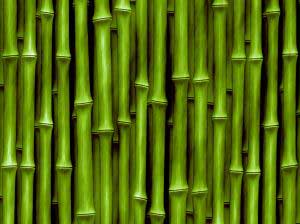
 As sustainable fabrics go, bamboo certainly has buzz on its side. I’ll admit to having fallen under its spell, though I ended up fairly unhappy with the durability of the socks and sheets I purchased while trying to avoid non-organic cotton.
Living here in Austin, I can attest that under the right conditions, bamboo doesn’t need the care (read: water) that even organic cotton does in order to thrive. There are yards all over the city where bamboo planted as a privacy screen has busted out all over. It’s like kudzu, only taller.
So the idea of using bamboo for fabric is extremely appealing. Plant it, ignore it, harvest it, fabricize it. It’s that last part that’s a problem. How exactly is thick, reedy bamboo turned into soft, fuzzy fabric anyway?
The answer is often chemicals. As the Organic Clothing blog and Victoria Everman have reported, a little bit of bamboo fabric is made by mechanical means in a very labor intensive process where they basically mash it up. The rest is made by cooking the bamboo in solvents that are neither eco-friendly nor safe for workers. Rebecca Clarren puts it like this in “Bamboo shoots and trees” on Salon.com:
Manufacturers of bamboo textiles use sodium hydroxide — one of the main ingredients in Drano — and carbon disulfide, to turn bamboo into a fiber that can be woven. Both chemicals are volatile organic compounds that can contribute to smog and of course can lead to a host of diseases if ingested.
The perception that all bamboo is grown without pesticides is also not necessarily correct, says Clarren, and she also notes that shipping the stuff all the way from China isn’t the greenest idea ever. I have no idea how to compare that to the savings in water from not using cotton, but she has a point.
The Organic Clothing blog notes that friendlier processes for producing bamboo fiber are starting to emerge, but they are not yet widespread.
I’m always looking for green products that don’t make me think. It’s so tempting to declare something “safe” so I don’t have to work so hard researching products. In this case, though, it seems that asking a few questions about how the bamboo was grown and processed is necessary before congratulating myself for living more lightly on the earth.

I feel like this is kind of sensational reporting – sodium hydroxide (“one of the main ingredients in Drano”) is also known as lye, and is used in a HOST of industrial ways, including to process food, soft drinks and paper. Even if you avoid bamboo treated with lye, you still probably blithely use other products that come in contact with lye. The way that sentence was phrased (I realize you didn’t write it, but were quoting someone else) was written so to elicit a gut reaction of horror from the reader, but the reality is that sodium hydroxide is a common chemical that is used in myriad ways in our society.
The point of your article is still useful – that bamboo has to be highly processed to be used as cloth – but I feel like you wrote this article and just quoted other blog writers, without delving deeper into the issue yourself.
Thanks for making us think!
I feel like this is kind of sensational reporting – sodium hydroxide (“one of the main ingredients in Drano”) is also known as lye, and is used in a HOST of industrial ways, including to process food, soft drinks and paper. Even if you avoid bamboo treated with lye, you still probably blithely use other products that come in contact with lye. The way that sentence was phrased (I realize you didn’t write it, but were quoting someone else) was written so to elicit a gut reaction of horror from the reader, but the reality is that sodium hydroxide is a common chemical that is used in myriad ways in our society.
The point of your article is still useful – that bamboo has to be highly processed to be used as cloth – but I feel like you wrote this article and just quoted other blog writers, without delving deeper into the issue yourself.
Thanks for making us think!
I feel like this is kind of sensational reporting – sodium hydroxide (“one of the main ingredients in Drano”) is also known as lye, and is used in a HOST of industrial ways, including to process food, soft drinks and paper. Even if you avoid bamboo treated with lye, you still probably blithely use other products that come in contact with lye. The way that sentence was phrased (I realize you didn’t write it, but were quoting someone else) was written so to elicit a gut reaction of horror from the reader, but the reality is that sodium hydroxide is a common chemical that is used in myriad ways in our society.
The point of your article is still useful – that bamboo has to be highly processed to be used as cloth – but I feel like you wrote this article and just quoted other blog writers, without delving deeper into the issue yourself.
Thanks for making us think!
I feel like this is kind of sensational reporting – sodium hydroxide (“one of the main ingredients in Drano”) is also known as lye, and is used in a HOST of industrial ways, including to process food, soft drinks and paper. Even if you avoid bamboo treated with lye, you still probably blithely use other products that come in contact with lye. The way that sentence was phrased (I realize you didn’t write it, but were quoting someone else) was written so to elicit a gut reaction of horror from the reader, but the reality is that sodium hydroxide is a common chemical that is used in myriad ways in our society.
The point of your article is still useful – that bamboo has to be highly processed to be used as cloth – but I feel like you wrote this article and just quoted other blog writers, without delving deeper into the issue yourself.
Thanks for making us think!
http://en.wikipedia.org/wiki/Sodium_hydroxide
http://en.wikipedia.org/wiki/Sodium_hydroxide
http://en.wikipedia.org/wiki/Sodium_hydroxide
I’m so glad that you wrote about this! I stopped using bamboo fiber in my yarn for this very reason. It’s not that it is ALL bad, it’s just much more chemically intensive than any other material I work with (local wool, organic cotton, etc)!
I’m so glad that you wrote about this! I stopped using bamboo fiber in my yarn for this very reason. It’s not that it is ALL bad, it’s just much more chemically intensive than any other material I work with (local wool, organic cotton, etc)!
I’m so glad that you wrote about this! I stopped using bamboo fiber in my yarn for this very reason. It’s not that it is ALL bad, it’s just much more chemically intensive than any other material I work with (local wool, organic cotton, etc)!
Heather, thanks for your comments! The Drano quote is definitely sensational, but I promise that wasn’t the entire basis for my opinion. The Organic Clothing blog article has a much more in-depth discussion of the issues, and Victoria’s blog post has a good Pro and Con summary. I’ve also seen a lot of these concerns echoed in other articles and blog posts over the last year or so.
Thanks for the link for those wishing to learn more!
I agree this is sensational reporting. Sodium Hydroxide is not the monster it is made out to be and the processes involved in textile manufacturing are completely closed, which
means that the release of byproducts into the environment is negligible. Sodium hydroxide is reactive but it is not toxic, i.e. it does not cause DNA damage, does not enter the food chain and is short lived because of its reactivity. It is easily neutralized into salt and water. Furthermore sodium hydroxide is used as a washing agent for
almost all organic cotton textiles and is certified by the global organic textile standards. The proof of the ecologically sound methods behind bamboo production is the fact that all bamboo fabric is certified under Oeko‐Tex Standard 100, which has become the best known and most successful label for textiles tested for harmful substances. Contrast this with conventional cotton and it is almost laughable to bring it up.
This article completely misses is the big picture: Bamboo as a natural resource is severly underutilized in the US. It is unfortunately necessary to bring bamboo in from Asia until it is shown to have a big enough demand to warrant making it a cash crop here in America. It is an amazingly versatile plant and we can only hope people will stop being so small minded about its potential impact.
I agree this is sensational reporting. Sodium Hydroxide is not the monster it is made out to be and the processes involved in textile manufacturing are completely closed, which
means that the release of byproducts into the environment is negligible. Sodium hydroxide is reactive but it is not toxic, i.e. it does not cause DNA damage, does not enter the food chain and is short lived because of its reactivity. It is easily neutralized into salt and water. Furthermore sodium hydroxide is used as a washing agent for
almost all organic cotton textiles and is certified by the global organic textile standards. The proof of the ecologically sound methods behind bamboo production is the fact that all bamboo fabric is certified under Oeko‐Tex Standard 100, which has become the best known and most successful label for textiles tested for harmful substances. Contrast this with conventional cotton and it is almost laughable to bring it up.
This article completely misses is the big picture: Bamboo as a natural resource is severly underutilized in the US. It is unfortunately necessary to bring bamboo in from Asia until it is shown to have a big enough demand to warrant making it a cash crop here in America. It is an amazingly versatile plant and we can only hope people will stop being so small minded about its potential impact.
I agree this is sensational reporting. Sodium Hydroxide is not the monster it is made out to be and the processes involved in textile manufacturing are completely closed, which
means that the release of byproducts into the environment is negligible. Sodium hydroxide is reactive but it is not toxic, i.e. it does not cause DNA damage, does not enter the food chain and is short lived because of its reactivity. It is easily neutralized into salt and water. Furthermore sodium hydroxide is used as a washing agent for
almost all organic cotton textiles and is certified by the global organic textile standards. The proof of the ecologically sound methods behind bamboo production is the fact that all bamboo fabric is certified under Oeko‐Tex Standard 100, which has become the best known and most successful label for textiles tested for harmful substances. Contrast this with conventional cotton and it is almost laughable to bring it up.
This article completely misses is the big picture: Bamboo as a natural resource is severly underutilized in the US. It is unfortunately necessary to bring bamboo in from Asia until it is shown to have a big enough demand to warrant making it a cash crop here in America. It is an amazingly versatile plant and we can only hope people will stop being so small minded about its potential impact.
Hello Skye
It seems that another issue to consider regarding bamboo for fabric production is that after the cellulose has been through the regeneration process it is the same as regenerated cellulose from other plants, raising the question that could the cellulose be sourced from elsewhere? One of my fellow Green Girls Global editors, Lee, has investigated this and offers some very interesting information and views in her article ‘How I was Floored by Bamboo’ here: http://greengirlsglobal.com/blog/how-i-was-floored-by-bamboo
Hello Skye
It seems that another issue to consider regarding bamboo for fabric production is that after the cellulose has been through the regeneration process it is the same as regenerated cellulose from other plants, raising the question that could the cellulose be sourced from elsewhere? One of my fellow Green Girls Global editors, Lee, has investigated this and offers some very interesting information and views in her article ‘How I was Floored by Bamboo’ here: http://greengirlsglobal.com/blog/how-i-was-floored-by-bamboo
Hello Skye
It seems that another issue to consider regarding bamboo for fabric production is that after the cellulose has been through the regeneration process it is the same as regenerated cellulose from other plants, raising the question that could the cellulose be sourced from elsewhere? One of my fellow Green Girls Global editors, Lee, has investigated this and offers some very interesting information and views in her article ‘How I was Floored by Bamboo’ here: http://greengirlsglobal.com/blog/how-i-was-floored-by-bamboo
Tom, thanks for the additional information. I’ll have to learn more about Oeko-Tex 100, since you say it’s about ecological soundness of production but also say it’s about testing for harmful substances – and while these may overlap, they’re not necessarily interchangeable.
Vicky, thanks for the link!
This is good food for thought, and at the very least raises awareness regarding what we believe to be ‘green’. From what I’ve read and researched there is a lot of ‘greenwashing’ done by manufacturers and marketers to try and sell a product, which may not be as sustainable as the manufacturer would like us to believe. Consumers need to question there assumptions, do some research and hold manufacturers more accountable. At our site we attempt to analyze the manufacturer, sourcing process and shipping hit for sustainable consumption.
-Will
http://www.growandmake.com
This is good food for thought, and at the very least raises awareness regarding what we believe to be ‘green’. From what I’ve read and researched there is a lot of ‘greenwashing’ done by manufacturers and marketers to try and sell a product, which may not be as sustainable as the manufacturer would like us to believe. Consumers need to question there assumptions, do some research and hold manufacturers more accountable. At our site we attempt to analyze the manufacturer, sourcing process and shipping hit for sustainable consumption.
-Will
http://www.growandmake.com
This is good food for thought, and at the very least raises awareness regarding what we believe to be ‘green’. From what I’ve read and researched there is a lot of ‘greenwashing’ done by manufacturers and marketers to try and sell a product, which may not be as sustainable as the manufacturer would like us to believe. Consumers need to question there assumptions, do some research and hold manufacturers more accountable. At our site we attempt to analyze the manufacturer, sourcing process and shipping hit for sustainable consumption.
-Will
http://www.growandmake.com
Even if bamboo fabric uses the same chemicals as does organic cotton, bamboo fabric has so many superior earth-friendly benefits than other “organic” fibers that we should promote it, not disparage it. When comparing bamboo to organic cotton, consider that bamboo is renewable and does not require replanting; harvesting bamboo is similar to mowing a lawn, but harvesting organic cotton requires the decimation of the entire crop causing bare soils to bake and release even more carbon into the atmophere; bamboo also absorbs more CO2 and produces more Oxygen than organic cotton or hemp. With everyone struggling to do the right thing ecologically, shouldn’t we try to encourage the use of yet another eco-friendly alternative rather than trash it? Wouldn’t we all be better off with a supremely soft, moisture-wicking, breathable and durable natural fabric to choose from?
Even if bamboo fabric uses the same chemicals as does organic cotton, bamboo fabric has so many superior earth-friendly benefits than other “organic” fibers that we should promote it, not disparage it. When comparing bamboo to organic cotton, consider that bamboo is renewable and does not require replanting; harvesting bamboo is similar to mowing a lawn, but harvesting organic cotton requires the decimation of the entire crop causing bare soils to bake and release even more carbon into the atmophere; bamboo also absorbs more CO2 and produces more Oxygen than organic cotton or hemp. With everyone struggling to do the right thing ecologically, shouldn’t we try to encourage the use of yet another eco-friendly alternative rather than trash it? Wouldn’t we all be better off with a supremely soft, moisture-wicking, breathable and durable natural fabric to choose from?
Even if bamboo fabric uses the same chemicals as does organic cotton, bamboo fabric has so many superior earth-friendly benefits than other “organic” fibers that we should promote it, not disparage it. When comparing bamboo to organic cotton, consider that bamboo is renewable and does not require replanting; harvesting bamboo is similar to mowing a lawn, but harvesting organic cotton requires the decimation of the entire crop causing bare soils to bake and release even more carbon into the atmophere; bamboo also absorbs more CO2 and produces more Oxygen than organic cotton or hemp. With everyone struggling to do the right thing ecologically, shouldn’t we try to encourage the use of yet another eco-friendly alternative rather than trash it? Wouldn’t we all be better off with a supremely soft, moisture-wicking, breathable and durable natural fabric to choose from?
I would like to know (or at least read opinions) how bamboo relates to NON-organic cotton in terms of environmental impact?
(I have got a sweater that is 50% bamboo/50% organic cotton. It is very comfortable to wear – and shows little sign of wearing out.)
Howver, as most ‘cotton’ clothing is still made form non-organic cotton I think it would be interesting ot know how bamboo compares.
I would like to know (or at least read opinions) how bamboo relates to NON-organic cotton in terms of environmental impact?
(I have got a sweater that is 50% bamboo/50% organic cotton. It is very comfortable to wear – and shows little sign of wearing out.)
Howver, as most ‘cotton’ clothing is still made form non-organic cotton I think it would be interesting ot know how bamboo compares.
I would like to know (or at least read opinions) how bamboo relates to NON-organic cotton in terms of environmental impact?
(I have got a sweater that is 50% bamboo/50% organic cotton. It is very comfortable to wear – and shows little sign of wearing out.)
Howver, as most ‘cotton’ clothing is still made form non-organic cotton I think it would be interesting ot know how bamboo compares.
Unfortunately there is no eco-friendly or organic fibre that will leave zero impact on our planet. We have just launched a baby clothing company in New Zealand manufacturing from organic and eco-friendly bamboo. After extensive research we can say that we absolutely love bamboo. Go Jan lets look for the positive and encourage development of this amazing fibre.
Unfortunately there is no eco-friendly or organic fibre that will leave zero impact on our planet. We have just launched a baby clothing company in New Zealand manufacturing from organic and eco-friendly bamboo. After extensive research we can say that we absolutely love bamboo. Go Jan lets look for the positive and encourage development of this amazing fibre.
Unfortunately there is no eco-friendly or organic fibre that will leave zero impact on our planet. We have just launched a baby clothing company in New Zealand manufacturing from organic and eco-friendly bamboo. After extensive research we can say that we absolutely love bamboo. Go Jan lets look for the positive and encourage development of this amazing fibre.
Pingback: 6 Sources for Organic and All-Natural Sewing Notions : Crafting a Green World
Pingback: Organic and natural sewing notions | The Canary Report
I am so happy to see bamboo fiber being rescued from what I think is a bit of a witch hunt. The current world population is 6,692,030,000+. If you don’t want to live on a farm and make all of your own clothing, food, materials etc., then you are going to be buying manufactured goods. Bamboo fiber, although chemicals are necessary to break it down, is the most eco friendly option out there, hands down. I actually made myself a comparison chart if anyone is interested in seeing it. Bamboo came out at the top. Nothing in the world of green is perfection, unless of course you are prepared to live off the land. What you do is you choose the least damaging option, the least impact on the earth. Unfortunately, you must ask the questions, research, so you can make informed decisions. Noone is going to make it easy on you in a free market economy. Nuff said. Except one more thing…I am not suprised the cotton industry would be unhappy with bamboo as a competitor fabric. Hmmm, I wonder how the cotton industry’s clout has affected the bad rep bamboo fiber is developing. Now there is something to chew on.
I am so happy to see bamboo fiber being rescued from what I think is a bit of a witch hunt. The current world population is 6,692,030,000+. If you don’t want to live on a farm and make all of your own clothing, food, materials etc., then you are going to be buying manufactured goods. Bamboo fiber, although chemicals are necessary to break it down, is the most eco friendly option out there, hands down. I actually made myself a comparison chart if anyone is interested in seeing it. Bamboo came out at the top. Nothing in the world of green is perfection, unless of course you are prepared to live off the land. What you do is you choose the least damaging option, the least impact on the earth. Unfortunately, you must ask the questions, research, so you can make informed decisions. Noone is going to make it easy on you in a free market economy. Nuff said. Except one more thing…I am not suprised the cotton industry would be unhappy with bamboo as a competitor fabric. Hmmm, I wonder how the cotton industry’s clout has affected the bad rep bamboo fiber is developing. Now there is something to chew on.
I am so happy to see bamboo fiber being rescued from what I think is a bit of a witch hunt. The current world population is 6,692,030,000+. If you don’t want to live on a farm and make all of your own clothing, food, materials etc., then you are going to be buying manufactured goods. Bamboo fiber, although chemicals are necessary to break it down, is the most eco friendly option out there, hands down. I actually made myself a comparison chart if anyone is interested in seeing it. Bamboo came out at the top. Nothing in the world of green is perfection, unless of course you are prepared to live off the land. What you do is you choose the least damaging option, the least impact on the earth. Unfortunately, you must ask the questions, research, so you can make informed decisions. Noone is going to make it easy on you in a free market economy. Nuff said. Except one more thing…I am not suprised the cotton industry would be unhappy with bamboo as a competitor fabric. Hmmm, I wonder how the cotton industry’s clout has affected the bad rep bamboo fiber is developing. Now there is something to chew on.
Now I know why I couldn’t tolerate bamboo socks that I bought at a well known clothing store.
Who would have thought that bamboo would have to undergo the use of so many chemicals!!!
Thanks for this article.
Sandy
Now I know why I couldn’t tolerate bamboo socks that I bought at a well known clothing store.
Who would have thought that bamboo would have to undergo the use of so many chemicals!!!
Thanks for this article.
Sandy