
The beautiful textiles made by the likes of Kirin & Co., Pippijoe, and Mod Green Pod are inspiring and beautiful, but they carry a designer price tag. If you can’t afford designer hand-printed fabrics, consider screen printing your own. By printing your own fabric you can control the materials used, the design, and colors.
Learn to Screen Print
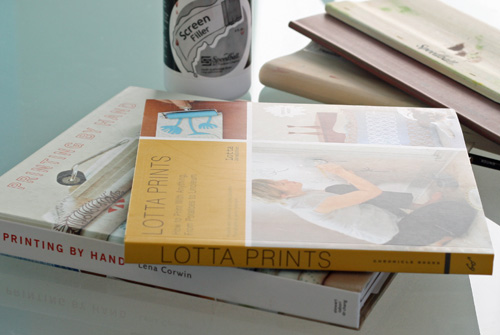
I recommend reading up on screen printing before you get started. While most hand printing methods seem overwhelming to a beginner, they are all quite easy to perfect with a little patience and practice. I highly recommend reading Lotta Prints by Lotta Jansdotter and Printing By Hand by Lena Corwin. Both of these books provide a thorough overview and how-to for each of the hand-printing methods. Each book also includes a few patterns from the author. Anna Laura, of the blog Anna Laura Art, shares a wonderfully detailed how-to for screen-printing with drawing fluid and screen filler.
Finding Base Cloth
Once you have read about screen printing and you are ready to try your own, you will need to find base cloth suitable for printing. First consider re-using fabric you already have. You can use material from bed sheets, curtains, flour sack dish towels, or tablecloths. If you need to buy fabric, Mod Green Pod offers organic cotton canvas for $15/yard (it is the same base cloth they use for their beautiful prints). Near Sea Naturals has a great selection of organic cotton and hemp fabrics suitable for printing. Start by searching for canvas.
Basic Supplies
Most art supply stores carry all the basic supplies for screen printing. You will need a screen, drawing fluid, screen filler, paint brushes, a squeegee, and ink (see more below). The screen and drawing fluid/screen filler can be expensive. For a cheap alternative check out the Cheap Screen Printing Tutorial for an alternative using an embroidery hoop, sheer fabric, and Mod Podge.
The Right Ink
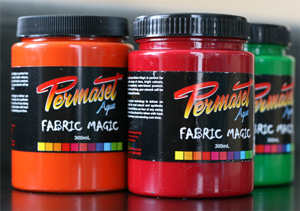 The final piece of the puzzle is the right ink. The most eco-friendly inks are water-based and non-toxic. The brand I personally use is Permaset Aqua by Colormaker. Their site explains the environmental benefits best.
Water based inks do not contain PVC or phthalates and are much more environmentally friendly. Permaset Aqua inks do not contain any toxic chemicals at all. It is formulated free from Lead and other heavy metals and passed the Oekotex Class 1 standard with 60% to spare. It is safe to use on baby clothes under 2 years, underwear and swimwear.
Permaset Aqua inks do not contain ozone-depleting chemicals such as CFC’s and HCFC’s, aromatic hydrocarbons or any volatile solvents. And you don’t need solvents to clean the screens down after they’ve been used – you can clean them with water.
In addition to printing on fabric, the Permaset Aqua inks can be used to print on other surfaces like paper and wood. Learn more about inks and get answers to the most frequently asked questions on the Permaset Aqua Blog.
Re-Use and Minimize Waste
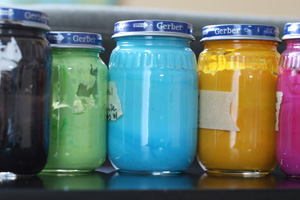 To be truly eco-friendly, you should strive to re-use materials and minimize waste as much as possible during the printing process. By printing your own fabric you are automatically minimizing waste, because your can print exactly the amount of fabric you need. After printing scoop excess ink back into a container for future use. I use old baby food jars to mix test colors and store small amounts of ink. When you are done using a particular design, the screen filler can be removed and the screen can then be re-used for a new design.




Pingback: Helping Craft a Green World | Tiny Décor Blog
Thanks for the info! I just tried creating a print using this screen filler method and now I can not get my screen clean, I scrubbed and scrubbed using a toothbrush and dishwashing soap and it’s not coming out. If you have any tips, please let me know! Thanks!
Thanks for the info! I just tried creating a print using this screen filler method and now I can not get my screen clean, I scrubbed and scrubbed using a toothbrush and dishwashing soap and it’s not coming out. If you have any tips, please let me know! Thanks!
Thanks for the info! I just tried creating a print using this screen filler method and now I can not get my screen clean, I scrubbed and scrubbed using a toothbrush and dishwashing soap and it’s not coming out. If you have any tips, please let me know! Thanks!
Hi
I saw in the section of getting your own base fabrics.There was a mention of getting an organic cotton canvas from modgreenpod for $15/yard.
I think you can get organic cotton canvas and other organic cottons/bamboo fabrics from Atlantis Fabrics(store.fabrics-textiles.com), for probably $8/yard.
Just thought that would help.
BUD
Hi
I saw in the section of getting your own base fabrics.There was a mention of getting an organic cotton canvas from modgreenpod for $15/yard.
I think you can get organic cotton canvas and other organic cottons/bamboo fabrics from Atlantis Fabrics(store.fabrics-textiles.com), for probably $8/yard.
Just thought that would help.
BUD
Hi
I saw in the section of getting your own base fabrics.There was a mention of getting an organic cotton canvas from modgreenpod for $15/yard.
I think you can get organic cotton canvas and other organic cottons/bamboo fabrics from Atlantis Fabrics(store.fabrics-textiles.com), for probably $8/yard.
Just thought that would help.
BUD
Gina,
Try using bleach & water (equal portions) to clean your screen. If it can remove photo emulsion, it can remove screen filler. Apply liberally to both sides of the screen, scrub gently with a scrub brush & let it set for 5 minutes. Repeat a few times until the screen is completely free of filler. If bleach is not eco-friendly for you, then use CLR (approved by the EPA). Remember to wear gloves.
Gina,
Try using bleach & water (equal portions) to clean your screen. If it can remove photo emulsion, it can remove screen filler. Apply liberally to both sides of the screen, scrub gently with a scrub brush & let it set for 5 minutes. Repeat a few times until the screen is completely free of filler. If bleach is not eco-friendly for you, then use CLR (approved by the EPA). Remember to wear gloves.
Gina,
Try using bleach & water (equal portions) to clean your screen. If it can remove photo emulsion, it can remove screen filler. Apply liberally to both sides of the screen, scrub gently with a scrub brush & let it set for 5 minutes. Repeat a few times until the screen is completely free of filler. If bleach is not eco-friendly for you, then use CLR (approved by the EPA). Remember to wear gloves.
Pingback: CraftStylish Crafty By Nature Challenge | Green
I am having a hard time finding eco friendly inks for linoleum block printing on fabric. The ones I have tried washed out, even when heat set. I’m close to going back to oil based inks which I really don’t want to do. Can you help? Thanks!
Hi! Did you ever find an answer to this question? I would love to hear it, if you have one. Thanks!
I am having a hard time finding eco friendly inks for linoleum block printing on fabric. The ones I have tried washed out, even when heat set. I’m close to going back to oil based inks which I really don’t want to do. Can you help? Thanks!
Hi! Did you ever find an answer to this question? I would love to hear it, if you have one. Thanks!
I am having a hard time finding eco friendly inks for linoleum block printing on fabric. The ones I have tried washed out, even when heat set. I’m close to going back to oil based inks which I really don’t want to do. Can you help? Thanks!
Hi! Did you ever find an answer to this question? I would love to hear it, if you have one. Thanks!
How does one heat-set the Permaset Aqua inks at home?
How does one heat-set the Permaset Aqua inks at home?
How does one heat-set the Permaset Aqua inks at home?
If you want to loni block print with Permaset on fabric, use a small foam roller rather than a normal rubber brayer. If you use the brayer, the ink will skid all over the lino. Foam roller works much better with the ink viscosity. Permaset prints, once properly heat set, have withstood 30 washes commercial @ 140’F. If it’s ashing out, it’s either not properly heat seat or the fabric still has size on the yarn.
Permaset can be heat set @ home using a hand-iron. The iron settings to use are listed on the label.
If you want to loni block print with Permaset on fabric, use a small foam roller rather than a normal rubber brayer. If you use the brayer, the ink will skid all over the lino. Foam roller works much better with the ink viscosity. Permaset prints, once properly heat set, have withstood 30 washes commercial @ 140’F. If it’s ashing out, it’s either not properly heat seat or the fabric still has size on the yarn.
Permaset can be heat set @ home using a hand-iron. The iron settings to use are listed on the label.
If you want to loni block print with Permaset on fabric, use a small foam roller rather than a normal rubber brayer. If you use the brayer, the ink will skid all over the lino. Foam roller works much better with the ink viscosity. Permaset prints, once properly heat set, have withstood 30 washes commercial @ 140’F. If it’s ashing out, it’s either not properly heat seat or the fabric still has size on the yarn.
Permaset can be heat set @ home using a hand-iron. The iron settings to use are listed on the label.
Use washing soda for cleaning your screen of screen filler, its available in the laundry section of the grocery store. Its super cheap for a box, just mix the powder with some water, brush on and let sit for a bit then scrub out with hot water, a sprayer on your sink helps. Its more environmentally friendly than bleach
Use washing soda for cleaning your screen of screen filler, its available in the laundry section of the grocery store. Its super cheap for a box, just mix the powder with some water, brush on and let sit for a bit then scrub out with hot water, a sprayer on your sink helps. Its more environmentally friendly than bleach
Use washing soda for cleaning your screen of screen filler, its available in the laundry section of the grocery store. Its super cheap for a box, just mix the powder with some water, brush on and let sit for a bit then scrub out with hot water, a sprayer on your sink helps. Its more environmentally friendly than bleach
Can this paint be used with the YuDu system! Our daughter has to have the least toxins to be able to continue screen printing. Toxins shut down her body!
How thick is the paint?
What do you do with dark colored shirt that you are putting white or light colored paint on!
Thank you!
Anta
Can this paint be used with the YuDu system! Our daughter has to have the least toxins to be able to continue screen printing. Toxins shut down her body!
How thick is the paint?
What do you do with dark colored shirt that you are putting white or light colored paint on!
Thank you!
Anta
Can this paint be used with the YuDu system! Our daughter has to have the least toxins to be able to continue screen printing. Toxins shut down her body!
How thick is the paint?
What do you do with dark colored shirt that you are putting white or light colored paint on!
Thank you!
Anta
I am looking for a screen printer that has experience in printing on decent quality Tea towels. I’m looking to order around 60 tea towels for an annual sorority get together.
I am looking for a screen printer that has experience in printing on decent quality Tea towels. I’m looking to order around 60 tea towels for an annual sorority get together.
I am looking for a screen printer that has experience in printing on decent quality Tea towels. I’m looking to order around 60 tea towels for an annual sorority get together.
Pingback: DIY Links and Resources « Momentary Musings
Where can I get these at a good price? Im allergic to most screen print inks and the ones Im not Im allergic to are expensive. Can someone help me out.
Where can I get these at a good price? Im allergic to most screen print inks and the ones Im not Im allergic to are expensive. Can someone help me out.
Where can I get these at a good price? Im allergic to most screen print inks and the ones Im not Im allergic to are expensive. Can someone help me out.
Hi there,
I’m trying to find an eco friendly way to remove the hardened emulsion from my screen (when I want to make a new design). I can’t seem to find much information on this and to my knowledge, the current screen ‘stripper’ chemicals on the market are pretty bad for the environment. Any suggestions would be appreciated. Thanks
In the past I’ve used a power washer to clear out the old emulsion. This can be tough on the screens, but you’ll still be able to re-use them a few times before it wears the fabric out. It might depend on the type of emulsion you use as well. When I was doing this I was using Ulano Proclaim Emulsion. Hope this helps!
Hey, nice post. Thanks for sharing yours view about screen printing. I think we can make screen printing more eco friendly by using the non toxic paint & other things which we used in screen printing… It will help to save the ozone layer from the depletion .I like your views. It’s good keep sharing with us.
Hey, great article. If you want to decrease your environmental impact, examine your choices of materials at every step of the screen printing process. You can use environmentally friendly fabrics, inks and papers.
Hey, great article. If you want to decrease your environmental impact, examine your choices of materials at every step of the screen printing process. You can use environmentally friendly fabrics, inks and papers.
Hi Jackie – thanks for this great article – I am planning to print my own second hand fabric using antique moveable type and referenced your article in my blog posting:
http://goodlinesdecor.com/2012/02/greening-a-favourite-old-chair-part-2-putting-a-wrap-on-it/