
This is a guest post by Becky Haas, an amateur crafter/environmentalist who also tries to make a living as a professional musician. You can also find her at the craft blog Sew and So.
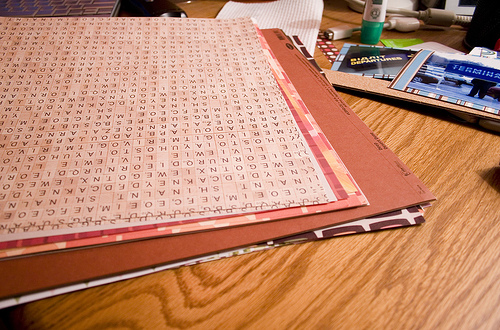 I’ve caught myself contemplating this quite a bit lately–whether it is actually possible for a craft that relies so heavily on paper to be done in a way that’s eco-friendly.
It seems that scrapbooking has a few extra challenges that makes it difficult to find supplies that are made from recycled materials. For one, the paper used as the base of the page has to be sturdy enough that it can handle having photos and other potentially bulkier items adhered to it–generally cardstock weight. This eliminates most, if not all, homemade and handmade papers. because they tend to be more fragile and tear easily. But the bigger challenge I’ve found in finding basic supplies is that most scrapbookers want stuff that is acid- and lignin-free.
According to Scrapbooking 101.net, the big deal with acid (which is used as part of the paper-manufacturing process) is that over time, it can cause photos and paper to disintegrate. And lignin, a component found naturally in the wood fibers that most paper is made from, can make paper discolor and turn brittle.
Since the whole idea behind scrapbooking is to preserve memories, it makes sense that the people who do it would want to try and make sure that their pages won’t fall apart before their currently non-existent great-grandchildren are around to gawk at their embarrassing prom pictures. The downside for the eco-conscious crafter, though, is that this creates an entire industry more concerned with making sure their products will be around for years to come than their environmental impact on the world that they’re hoping to pass these memories on to.
Digital scrapbooking is an option, of course, for those who really want to avoid all the paper useage. Layouts can be created on the computer using photo-editing software, and printed on whatever recycled paper you want. Or just left on your computer, if you prefer.
This method isn’t without its problems, though. While soy- and vegetable-based inks are becoming more popular for business use, they aren’t readily available for home use in place of petroleum-based inks. Not to mention the energy used to power the computer. And for people who enjoy the tactile experience of creating something with their hands over the click of a mouse, there’s still a need for supplies.
Fortunately, it’s getting increasingly easier to find more eco-friendly options. For example, a company called Piggy Tales has begun printing its paper on recycled paper with soy-based inks. The Scrapbook Pantry also has a section for paper printed on recycled, 30% post-consumer paper with soy-based inks.
One of the most encouraging moves is by one of the major suppliers, K & Company, who have a line they’ve put out recently called “ReMake”. According to the website, “All Remake products are printed using soy-based inks and created using sustainable manufacturing practices and recycled 100% post-consumer waste. Plus, our paper packaging is made with 100% PCW and is reusable by our printed designs that you cut out to embellish your projects. Even the clear protective bags are made from corn-based materials. We’ve redesigned the basics to be even better so that we can all remember responsibility.” Hopefully more craft paper manufacturers will take a cue from these companies and work towards producing papers that are both scrapbook- and earth-friendly.
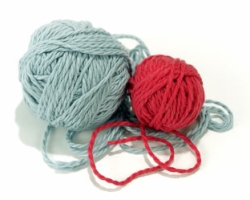
Another option, particularly for younger scrapbooker-wannabes who aren’t really into the cutesy products designed more for moms with young kids than, say, a childless single 20-something, is to use recycled goods to decorate pages. For instance, rather than buy those overpriced packs of ribbon and fiber from the craft stores, why not take the scraps too small for knit or crochet projects off the hands of your yarn-crafty friends? Parts from that broken watch you were going to throw out can become cheap embellishments to go with some pictures of that steampunk-themed Halloween party you have coming up.
Other ideas are to use the parts from broken pieces of jewelry, or more everyday things like bottlecaps, pages from thrift-store books, those leftover scraps of fabric from your last sewing project…the possibilities are endless. (For more ideas, or examples with pictures, check out these articles from Scrapfriends, Scrapbooks Etc., Scrapbooking.com, and The Worsted Witch. And if you’re concerned about the acid content, just be aware that reused paper products may contain it.)
There’s a whole lot of other basic supplies that I haven’t found much information about yet, as far as their environmental impact goes– namely adhesives and page protectors (since we all know how bad clear vinyl can be). I’d love to hear any thoughts on finding eco-friendly versions of these, or any alternative products!
Image credit: sarea at Flickr, under a Creative Commons license

Pingback: Crafting a Green…Scrapbook? | EcoTaz green lifestyle and technology blog
THANKYOUTHANKYOUTHANKYOUTHANKYOU
There, have i said it enough?
Every time I go to s scrapbook site or blog and try to ask about eco-friendly supplies, all I get is the online equivalent of grunts in reply.
This is the first place I have seen any mention of places to get recycled scrapbook papers, and you even posted links!
Love the tip on reusing old hardware like watch parts. I have a couple of containers full of bottle caps, washers, and other (relatively flat) found objects to use on my pages. I haven’t yet found a glue that will hold some of these items, but they can be attached with a couple of stitches or some wire.
It is also neat to use these things as impromptu stamps, or make rubbings of them, or use them as a texture over which to emboss. Some found objects also make decent stencils. I wouldn’t want to use a plastic mesh onion bag on my page, because of the type of plastic, but I can dab paint or ink over it, and it can be re-used indefinitely.
Also, there are scrapbook safe oven-bake or air-dry clays on the market now in addition to things like paperclay, so found objects can be used as molds to make multiple embellishments. For the digital bookers out there, this stuff can be scanned and shopped to make digital doodads in a snap.
About the archival safety concerns, it really all depends on what type of scrapbook you’re doing. Ins some instances, old treasured family photos of the g-g-grandparents and newspaper clippings of their wedding will most assuredly merit the full archival treatment. However, if you’re just doing day-to-day stuff, keep backups of the photos on your computer, and use whatever items suit the mood of the pics.
Thanks for an amazing post.
There, have i said it enough?
Every time I go to s scrapbook site or blog and try to ask about eco-friendly supplies, all I get is the online equivalent of grunts in reply.
This is the first place I have seen any mention of places to get recycled scrapbook papers, and you even posted links!
Love the tip on reusing old hardware like watch parts. I have a couple of containers full of bottle caps, washers, and other (relatively flat) found objects to use on my pages. I haven’t yet found a glue that will hold some of these items, but they can be attached with a couple of stitches or some wire.
It is also neat to use these things as impromptu stamps, or make rubbings of them, or use them as a texture over which to emboss. Some found objects also make decent stencils. I wouldn’t want to use a plastic mesh onion bag on my page, because of the type of plastic, but I can dab paint or ink over it, and it can be re-used indefinitely.
Also, there are scrapbook safe oven-bake or air-dry clays on the market now in addition to things like paperclay, so found objects can be used as molds to make multiple embellishments. For the digital bookers out there, this stuff can be scanned and shopped to make digital doodads in a snap.
About the archival safety concerns, it really all depends on what type of scrapbook you’re doing. Ins some instances, old treasured family photos of the g-g-grandparents and newspaper clippings of their wedding will most assuredly merit the full archival treatment. However, if you’re just doing day-to-day stuff, keep backups of the photos on your computer, and use whatever items suit the mood of the pics.
Thanks for an amazing post.
There, have i said it enough?
Every time I go to s scrapbook site or blog and try to ask about eco-friendly supplies, all I get is the online equivalent of grunts in reply.
This is the first place I have seen any mention of places to get recycled scrapbook papers, and you even posted links!
Love the tip on reusing old hardware like watch parts. I have a couple of containers full of bottle caps, washers, and other (relatively flat) found objects to use on my pages. I haven’t yet found a glue that will hold some of these items, but they can be attached with a couple of stitches or some wire.
It is also neat to use these things as impromptu stamps, or make rubbings of them, or use them as a texture over which to emboss. Some found objects also make decent stencils. I wouldn’t want to use a plastic mesh onion bag on my page, because of the type of plastic, but I can dab paint or ink over it, and it can be re-used indefinitely.
Also, there are scrapbook safe oven-bake or air-dry clays on the market now in addition to things like paperclay, so found objects can be used as molds to make multiple embellishments. For the digital bookers out there, this stuff can be scanned and shopped to make digital doodads in a snap.
About the archival safety concerns, it really all depends on what type of scrapbook you’re doing. Ins some instances, old treasured family photos of the g-g-grandparents and newspaper clippings of their wedding will most assuredly merit the full archival treatment. However, if you’re just doing day-to-day stuff, keep backups of the photos on your computer, and use whatever items suit the mood of the pics.
Thanks for an amazing post.
Pingback: Recycled Kraft Paper for Scrapbooking : Crafting a Green World
Scrapbook Pantry is always looking to add new recycled papers to our already large collection. Visit us at Scrapbookpantry.com
Scrapbook Pantry is always looking to add new recycled papers to our already large collection. Visit us at Scrapbookpantry.com
Scrapbook Pantry is always looking to add new recycled papers to our already large collection. Visit us at Scrapbookpantry.com
I am working on finding a printer to print our scrapbook paper designs onto 100% recycled paper… it’s been an uphill battle. The paper is expensive especially for good quality recycled papers… Now I’m worried that I won’t be able to find anyone willing to pay the extra for it to be eco friendly!
How much would you pay for eco friendly scrapbook paper and supplies? Would you prefer thin paper or thick cardstock?? I’d love to know if there is interest out there before venturing to pay for a big print job. I’d love feedback, easiest is to post on our wall: http://www.facebook.com/twocraftychicks
Thanks!
I am working on finding a printer to print our scrapbook paper designs onto 100% recycled paper… it’s been an uphill battle. The paper is expensive especially for good quality recycled papers… Now I’m worried that I won’t be able to find anyone willing to pay the extra for it to be eco friendly!
How much would you pay for eco friendly scrapbook paper and supplies? Would you prefer thin paper or thick cardstock?? I’d love to know if there is interest out there before venturing to pay for a big print job. I’d love feedback, easiest is to post on our wall: http://www.facebook.com/twocraftychicks
Thanks!
I am working on finding a printer to print our scrapbook paper designs onto 100% recycled paper… it’s been an uphill battle. The paper is expensive especially for good quality recycled papers… Now I’m worried that I won’t be able to find anyone willing to pay the extra for it to be eco friendly!
How much would you pay for eco friendly scrapbook paper and supplies? Would you prefer thin paper or thick cardstock?? I’d love to know if there is interest out there before venturing to pay for a big print job. I’d love feedback, easiest is to post on our wall: http://www.facebook.com/twocraftychicks
Thanks!
Hi. I also have been looking for more ideas on how to use or reuse the supplies we have, whether from normal scrapbook material or things around the house, like toilet paper rolls. I did find some ideas.
I think one idea that manufacturers should try is recycling scrapbook paper itself. I know that normally they encourage us to use every piece of paper we have and that is good. That is also a Native American idea…to use all of something in one manner or another.
What I do when I realize I am using material that is not acid-free, like if I use a real flower, then I spray it with an adhesive like Krylon. When I have done that, it lessens, if not completely takes out any acidity that would affect other material it is laid against. I believe there are ways to go about using recycled paper and keeping to the archival quality of our work. Even the scrapbook paper we would normally get from the stores had to originally have come from some tree just like your regular copy paper. I also think that computers are another useful device. When you get down to it, everything we use has come from the earth in one form or another..it was just turned into something useful for us humans…which by the way, I don’t see humanity as a blight on the earth as some do. But we should be good stewards.
Thanks for the article. I also like your webpage. Very cool.