
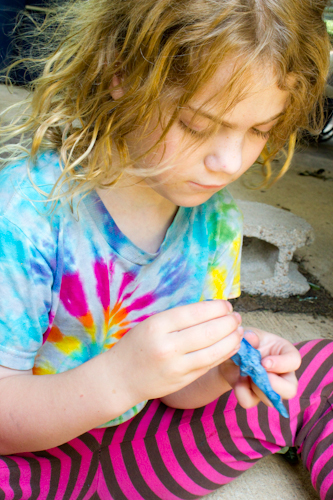
Modeling beeswax is a lot of fun, and your kids can learn quite a bit from helping you make a batch. Here’s how to make modeling beeswax from all natural ingredients!
Most of our homeschooling happens through hands-on activities. Baking bread involves the math of the measurements, the science of the yeast, the history of growing wheat, the geography of different types of loaves. Watercolor painting involves the art of the color wheel, the biographies of other artists who have painted in watercolor, the science of color mixing and how not to make one’s colors look like mud.
When my girls and I make modeling beeswax together, we follow my recipe using math skills, but we also have time to relax and enjoy the warm honey scent of melted beeswax. We can think about color theory, or just dye the liquid modeling wax whatever colors please us the most. We can talk about bees and the work that they do, or we can simply talk about our day as we warm the wax in our hands and craft our favorite sculptures. In other words, we can learn and we can play, which is how I best like our days to go.
Store-bought modeling beeswax is wonderful to play with, but it’s also expensive. With the following recipe, you can make your own modeling beeswax just as naturally for a fraction of the cost, and soon you, too, can be learning and playing and creating for your best day.
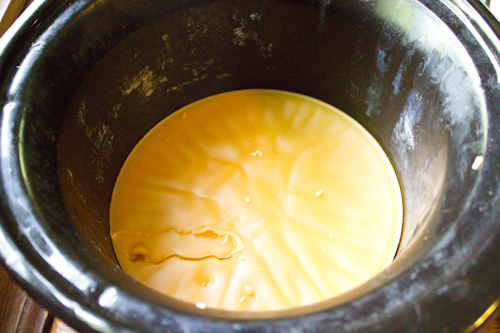
To begin, heat a pound of beeswax in a double boiler or crockpot until it’s melted. Our modeling beeswax will be made using food-grade ingredients, so you can use your kitchen crockpot for this recipe, but if you have a thrifted crafts-only crockpot, such as the one that I used when I demonstrated how to make hot-process soap, then so much the better.
To your melted pound of beeswax, add the following ingredients:
- five tablespoons of olive oil
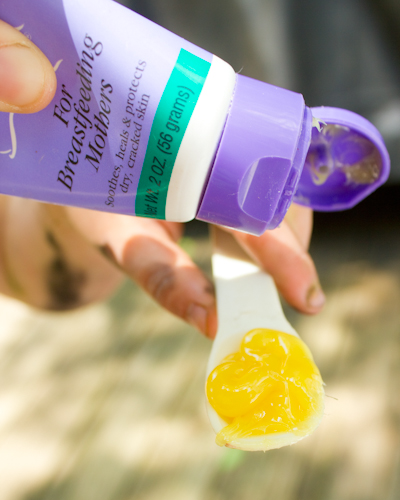
- four teaspoons of lanolin
Lanolin can be found in a farmer’s co-op, natural parenting store, or any other place that sells organic wool or caters to farmers. As you can perhaps tell, the lanolin that I’m using is from the baby aisle of my big-box grocery store–it’s the last of a tube of nipple cream that I bought when I first began breastfeeding my firstborn daughter. I used it so sparingly during the approximately five years that I nursed two kids that I had plenty left over to use for modeling beeswax!
Now, this recipe may not be completely accurate for you the first time, because beeswax is quite variable in quality and consistency. Now that I always buy my beeswax from the same woman at the farmer’s market I’ve been able to standardize my recipe, but you may need to play around a little with the amount of your ingredients. The best way to see if your recipe is sound is to turn off the heat and let your modeling beeswax solidify right in the pot.
Once it’s cool, serve yourself up a spoonful, warm it in your hands until it’s supple, and begin to play with it. If the modeling beeswax is hard to make supple, or it crumbles in your hands, then add more olive oil a tablespoon at a time AND more lanolin a teaspoon at a time. If the modeling beeswax works but it’s sticky, then add only olive oil, a tablespoon at a time. It’s unlikely that your modeling beeswax will be too supple and refuse to hold its shape when molded, but if that is the case for you, then add more beeswax, a quarter-cup at a time.
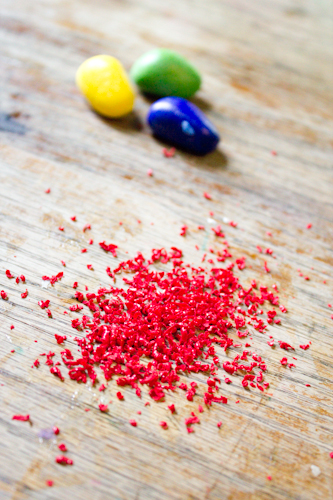
When you’re happy with the quality of your modeling beeswax, you may now color it. To do so, remelt the modeling beeswax in its original pot. You can play with natural dyes, but I find it quick, easy, and effective to simply color my modeling beeswax with soy crayon rocks. Grate one soy crayon rock and scoop the shavings into a plastic container that’s on its way to the recycling bin, anyway. Pour one cup of melted modeling beeswax into the container, and stir well to melt the shavings and combine them with the modeling beeswax.
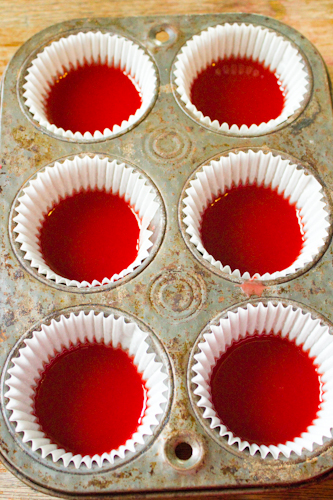
To divide the modeling beeswax, pour the cup of colored wax into a muffin tin with cupcake liners inserted. One cup will divide nicely into six cupcake liners.
Repeat to create all the different colors that you want (don’t forget to leave some plain!), and let them cool completely in their cupcake liners.
When the modeling beeswax is completely cool, you can store it in its cupcake liner. To play with it, peel it away from the liner, admire how delicious it looks–like a colored Reese’s Cup!–and hold it in your hands to warm it up.
Warming up the beeswax so that it’s supple enough to mold takes several minutes. My girls don’t have the patience to warm up a whole piece by themselves, and anyway it would just take them longer in their tiny little hands, so I warm their modeling beeswax for them, then give it to them when it’s almost ready, so that they only have to do a little work before they can begin to play.
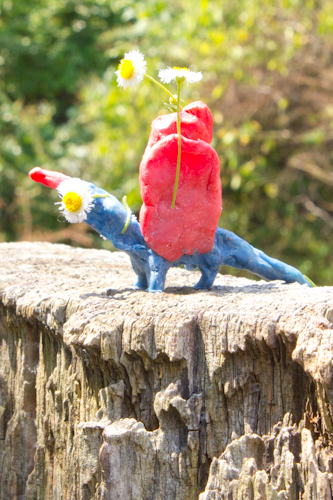
The last time that we all played with modeling beeswax, out in the sunshine in front of my Papa’s house, Willow and I made this red and blue dragon, and Willow crowned it with flowers and enthroned it on a tree stump. What will you make?




Hi, Thank you for this easy recipe, I’d like to know if it is air dry or not. Thanks
Modeling beeswax relies on warmth to make it malleable. When you stop touching it with your warm hands, it will firm up and remain as firm as any other clay without drying out. If you rewarm it, however, perhaps by soaking it in a bowl of warm water, it will regain its malleability, allowing you to re-use it.
Thanks for the tutorial. I’ve been seeing the beeswax clay, but everyone seemed to be using stockmar. We have our own bees, so ‘naturally’ I’ve been wanting to try my hand at making some.
I do like Stockmar modeling beeswax, too, but yeah–if I can make something myself, then I DO!
Hi,
I just wanted to pop in and thank you for the wonderful tips! I’ve been trying to make my own beeswax-based clay and it wouldn’t stick together. Finally it dawned on me to use lanolin- but I didn’t know about mixing in oil and lanolin together at the same time. I’m curious, what purpose does the oil serve? I know that it makes the clay softer, but in the case of petroleum-based clay, it will cause the powder to separate from the wax if you add too much.
Great tutorial, keep ’em coming!
-Don C.
Mind you, I haven’t done a ton of experimentation, because once I hit upon my recipe I stuck with it, but I’m under the impression that the oil helps make the beeswax more malleable. The lanolin does, too, but lanolin itself is still quite thick, and sticky. I’ve never had a problem with adding too much oil to modeling beeswax, but I have added too much oil to a flour play dough recipe that I was experimenting with once, and the oil DID separate out–gross!
Heh, it’s worse when you try to mix mineral oil with canning paraffin! Weird stuff. I like lanolin, but it’s very expensive where I am. Always looking for a big tub of it. I would use Bag Balm, but it’s a mix of lanolin and petroleum jelly and it kind of reeks of a menthol smell.
So, olive oil will actually make beeswax less sticky? I always thought you had to add some kind of powder like talc or corn starch. Honestly, I wouldn’t experiment so much, but I have a bunch of different waxes and can never seem to buy modeling clay off the shelf that is just right for animation. I’m always adding something to it to improve its consistency. The biggest problem has always been that the stuff sticks to my tools. When it’s crumbly AND sticky, though, that stumps me every time. I think it’s cool you found a ratio that works for you. Hoping some of your luck will rub off on me!
Pingback: Bath and Body Beeswax Recipes (and a Few Recipes to Keep Your House Honey-Sweet, Too)
Thank You so much for sharing this, I have been thinking about this for a long time, my kids go to a waldorf school and I like modeling beeswax so much better than clay, but you are right it’s so expensive so I really look forward to trying this…
Would regular crayons work for coloring as well? I have everything here that we need but no soy rock crayons. Thanks!
Regular crayons will definitely work. I suggest soy crayons only because regular crayons (ie. Crayola) contain petroleum by-products. If you’re wanting to make modeling wax specifically to be a natural art supply, then you’ll want to use a completely natural pigment. If, however, you’re making modeling wax just to have another super-fun art supply, then conventional crayons will do.
Pingback: Crafting a Green World | How-to: Save and Store Melted Wax for Future Craft Projects | Page: 1 | Crafting a Green World
Thank you very much for your orientation. I did beeswax for modeling, and I m n ot sure it s ok.
Compared to Stocmar my clay is not bright and it leaves the hands “dirty”. What can I add to make my modelling beeswax more “elastic”, It is sticky and does not strech.
I used exactly your ingredients…but maybe my bees are different 😉
If it’s sticky, it needs more oil.
thanks so much it works great as nose and scar wax 😀 i just leave it a little sticker than usual thanks so much 😀
Love this!! Would food coloring gel work as a dye or what other options are there? I don’t have soy crayons, only regular Stockmar…and you know I’m not melting those:):)
I’m allergic to lanolin, is there some substitute. It looks really wonderful otherwise and I want to try it with my girls.
Pingback: Crafting a Green World | How-to: Homemade Solid Body Lotion for Natural Skin Care | Page: 1 | Crafting a Green World
Please, what on earth is a soy crayon rock and where would I get one?
Thanks!
There are several different companies that make them, but here’s what they look like:
http://crayonrocks.net/
Hi think my modelling wax needs some help. Can’t decide at this point whether to continue or start again and was hoping you might know if it is salvageable. Wax is at this point crumbly and soft and will stick to table and hands but will form a ball etc. if I roll a tube shape it will hold but I can just break it into pieces and when cooled is still softish not hard . not sure what to do with it. First added more and more lanolin and oil and then added more wax and now not sure.
It sounds like you may need more wax, since the beeswax is what adds strength and hardness. You can play around and salvage this batch, but what you may need to do is first, write down exactly how much of everything you’ve added, then set it aside and make a new batch slowly, adding the ingredients a little at a time and testing often until you have the correct consistency for you, making note of exactly how much of everything that you’ve used at all times. Once you have a good first batch and you’ve verified a good recipe that works for you, then you’ll know what to add to correct your original batch.
Thanks so much love your site I hate to waste great advice x
Pingback: The Epic Guide to Beeswax Modeling in Kindergarten
Thank you from Plettenberg bay in South Africa. It is great to have this recipe as everything is so expensive from Germany – just look at the exchange rate today!
HI, great post. thanks!
What could replace the lanolin?
hi there! im so glad i found this and looking forward to trying this. could you tell me where to find the soy rock crayons?
Pingback: Moldable Beeswax – Natasha Kocher, RECE
Any hints is this comes out hard as a rock, then “warms” to monumentally sticky?
I tried this and it turned out okay but not the greatest consistency. Still fun, but since our waldorf homeschool curriculum uses it so much I’m going to put the money into Stockmar. Stockmar uses 64% paraffin, 30% beeswax, 3% Venetian turpentine, and 3% pigments. Someday maybe I’ll have time to try this again with paraffin. Here is an information sheet from Stockmar which talks about why they use paraffin: https://www.gasungen.no/users/viviansnettbu_mystore_no/images/stockmar_modellierwachs_paraffin_bwachs_en.pdf