
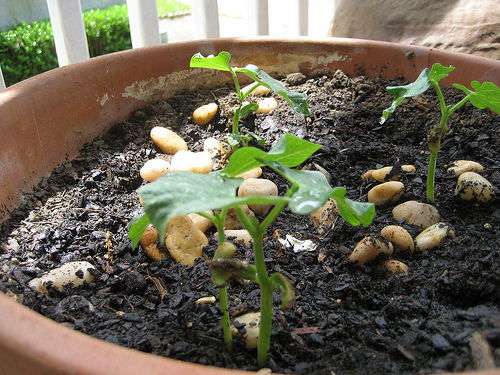
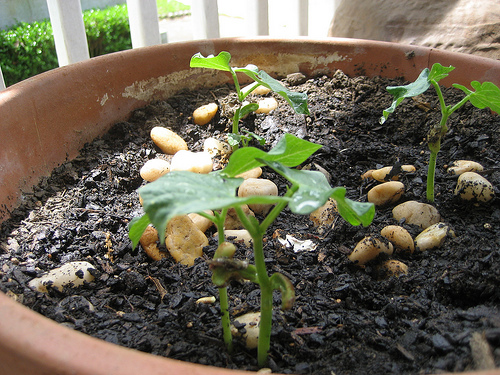
[These little cucumber sprouts were seeds just a week ago!]
The weather is warming up, and it’s about the right time to start planting your spring garden! Whether you’re living in an apartment with just a little bit of window or patio space or a house with a yard, you can still grow some of your own food to save a little cash and reduce your food miles. Rather than spend money all season on expensive (and often petroleum-derived) fertilizer, why not get yourself a worm bin, and make your own nutrient-rich compost?
If you have a lot of yard space, you can build yourself a full-sized compost bin. Vermicomposting, compost bins where worms do the work breaking down the organic matter, are great for folks with a less space, but you homeowners can benefit from a worm bin, too! Worm castings are super-nutritious, and worm bins yeild good compost relatively quickly. The bins are easy to make yourself, and you can even divert some waste from the landfill while you’re at it! Bonus points if you rescue discarded plastic tubs, rather than buying new ones. Check out this awesome step-by-step video on getting your worm bin together:
[youtube=http://www.youtube.com/v/WxhEQEA0GN8&hl=en&fs=1]
You might check Craigslist or Freecycle for some bins that you can use.
If even the worm bins would take up too much space in your pad, you might look into a bokashi compost bin instead. Bokashi uses microorganisms to break down food waste. The mixture can be a bit pricey, but it’s another situation where you can use your DIY skills to save some cash. Check out this video on making your own bulk bokashi!
Composting is a great way to help fight global warming. When food scraps go to the landfill they break down and let off methane, a powerful greenhouse gas.
Are you planning to get your spring garden going? What sorts of things are you planting?






Oh, I’m so glad to see you posting about this. I think that every single household in the world should have a worm composting bin. To that end, I’ve put up insanely detailed instructions on my site.
I’d like to remind people that a regular sized bag of worm castings at the home gardening center costs 50 bucks! I’m sure we’ve made close to a thousand dollars worth of this stuff. And we haven’t thrown away any produce waste in almost 5 years.
If anyone’s interested, I’m incredibly happy to answer any questions that anyone has about this.
I want to build the worm bin expressly to use the castings in the soil mix for seedlings. Along with perlite, soil, coir this mix will guarantee to bring those seeds up with less watering, less handling and better strong growth! We have an off-grid 22 acre farm in the Coastal Mountains of Humboldt County, Ca.
whats the best way 2 get the dirt out of the compost bin .please help
It depends on your bin, but I have found that a small trowel works just fine for a small bin and a shovel is good for a big, backyard bin.
My garden is going strong@ Right now I have lots of herbs and greens and this week I’ve planted peas, brussel sprouts and reseeded my kale, spinach and lettuce. Oh and some summer bulbs too!
Thank you thank you thank you! I agree with Wendy–every household should have a worm composting bin. Our family’s favorite is “The Worm Factory”–it’s a fantastic tiered system where the worms eat their way upwards through the bins, plus the worm tea is filtered into a bottom container with a spout so that you can use the worm tea for household plants, lawns, etc. Super simple! Plus, my kids have become worm fanatics and love to help me with them. Who knew getting kids to take out the food scraps could be so easy!
Hi,
Where do I purchase the worms or can I use the ones that are out in my soil in the yard?
Thank you,
Crystal
Crystal, if you search ‘compost worms’ you’ll get a lot of places that sell them online. And yes, they send you a big package of worms. You can use the ones in your yard, but since you’ll generally want to start off with about a pound, it’s better to buy them if you can. (Then again, if you have a yard, normal composting is an option for you; the worms will find it on their own.)
Pingback: DIY Gardening: Craft Projects to Spruce Up Your Garden
Those are bean sprouts, not cucumber sprouts.
Oooh! Good to know! That’s what I get for not using markers on anything. Now I just need to remember which pot has the cucumbers…
Howdy. Nice video for a really simple plastic bin.
You also might want to consider wood as a material for your compost worm bin. I’ve been vermicomposting for about 5 years now, first with a styrofoam cooler, then a plastic bin, and finally moved to wood. I prefer wood because it breathes better and also absorbs excess moisture (helps prevent the bin from getting too wet and stinky). It’s a bit more work to build a bin out of wood, but you avoid buying more plastic that will eventually go in a landfill.
I have some pictures up on my blog of the wooden bins I use: http://vermontworms.com/red-wiggler-compost-worm-bin/. They’re pretty easy to put together.
Have fun with vermicomposting! -Jase
Thanks for the tips, Jase! I like the look of a wooden bin better than a plastic one, too. Great post!
Can you add worms to a regular compost bin or do they need to be seperate?
It shouldn’t hurt your bin to have worms in there. That said, I know worms need certain conditions to thrive. This page has some great worm feeding tips:
http://www.vermicompost.net/worm-composting/bin-food/what-do-worms-eat.aspx
Impressed, surprized & tickled pink! This is my 1st visit & won’t be my last!
Joyous thanks to all
Impressed, surprized & tickled pink! This is my 1st visit & won’t be my last!
Joyous thanks to all
Yes, the bokashi is very pricey. I’ve added a liquid soil inoculant, mixing it about 80:1 with water, which makes it only pennies to use in compost piles and worm bins as well. It even speeds up the composting time of wood, and provides the microbes red worms need to digest.
The two most important factors when trying to compost with red worms is keeping the worm bin at the correct moisture and the correct ph. Your worms won’t be able to breath if the bedding becomes either too dry or too wet. The ph must remain very close to neutral to keep your worms healthy. Here is more information on these two important considerations when red worm composting.
Nice video! I just got the worms I bought online, should I add them to my bin with the “earth” they bring or should I remove them from the earth before adding them?
Is this a good compost bin
This video was detailed and easy to understand. The end left me hanging as far as how to add the worms. Do I just lay them on top or lift the layers and add them?
I realize that this video was about how to set up a worm bin, however, it would have felt more well rounded to add how often and how much scraps to add once the worms are in place and any other added tips.
Hey, nice information about preparation of worm composting bin. I am preparing vermicomposting in a small form and this information helps me to do this process in a different way. thank you and keep posting new methods.